

Curriculum
Curriculum
Unit 6 - The 2026 Supreme Court Review: Defending the Distinction in Women’s Sports
Introduction
Overview
We are living through a historic moment for women’s sports, Title IX, and constitutional law. In January 2026, the U.S. Supreme Court heard two major cases challenging the constitutionality of state laws in Idaho and West Virginia that prohibit transgender athletes from participating in girls’ and women’s sports.
This unit examines the legal arguments advanced in defense of Idaho’s Fairness in Women’s Sports Act and West Virginia’s Save Women’s Sports Act. Students will analyze the constitutional and statutory claims raised in these cases, with particular attention to how the states argue that sex-based (biological) distinctions are necessary to preserve fairness, safety, and athletic opportunity for female athletes.
Although the cases arise from laws in just two states, the Court’s review—and its eventual decision—could have far-reaching implications for school athletics nationwide, the interpretation of Title IX, and the permissible scope of sex-based classifications under the Constitution.
The Supreme Court
The Road to the High Court: How a Case Reaches SCOTUS
Step 1: The Trial Court
- What happens: Someone files a lawsuit because they believe a law is unfair or unconstitutional.
- The Action: Lawyers present evidence, witnesses testify, and a judge or jury makes a decision.
- The Result: One side wins, and the other side loses.
- Example: In the Idaho case, the trial court judge (Judge Nye) initially blocked the law, saying it was likely unconstitutional.
Step 2: The Court of Appeals
- What happens: The losing side is unhappy with the decision and asks a higher court to review it. This is called an “appeal.”
- The Action: There are no new witnesses or evidence. Instead, a panel of three judges reviews the written arguments to see if the first judge made a legal mistake.
- The Result: The appeals court either agrees with the lower court (“affirms”) or disagrees (“reverses”).
- Example: In the West Virginia case, the Court of Appeals reversed the lower court’s decision, saying the law violated Title IX.
Step 3: The Request (Petition for Certiorari)
- What happens: The side that lost in the Court of Appeals still thinks they are right. They send a formal request to the Supreme Court called a “Petition for Certiorari” (or “Cert Petition”).
- The Odds: The Supreme Court gets about 7,000–8,000 of these requests a year but only accepts about 60–70 of them. They usually only pick cases that involve a major national issue or where different appeals courts disagree on the same law.
Step 4: The “Rule of Four”
- What happens: The nine Supreme Court Justices meet in private to vote on which petitions to accept.
- The Action: If four of the nine Justices vote to hear the case, it gets placed on the calendar.
- The Result: This is called “granting cert.” The case is now officially going to the Supreme Court.
Step 5: The Supreme Court (The Top Rung)
- What happens: Both sides submit written arguments (briefs). Then, the lawyers appear in person to argue before the nine Justices (Oral Arguments).
- The Decision: The Justices vote, write their opinions, and issue a final ruling that becomes the law of the land.
Idaho: Little v. Hecox
Background of the Case
The law (H.B. 500 — “Fairness in Women’s Sports Act,” 2020): In 2020, Idaho enacted H.B. 500, the first law in the United States to categorically bar transgender women and girls (biological males) from participating on female sports teams at public schools and public universities. The law also created a “dispute” process that allowed someone to challenge a student’s sex, potentially triggering a requirement for sex verification through medical procedures—such as genital examinations or genetic testing—raising major privacy and bodily autonomy concerns.
The Plaintiffs
- Lindsay Hecox: A transgender woman and Boise State University student who wanted to try out for the women’s cross-country and track teams. She argued that
she had undergone hormone therapy to suppress testosterone and therefore should be eligible to compete. - Jane Doe: A cisgender high school girl who joined the lawsuit because she feared the law’s sex-dispute procedures could subject her to invasive verification if someone challenged her sex.
Lower Court Decisions
Shortly after the law was passed, U.S. District Judge David Nye issued a preliminary injunction, preventing it from taking effect. The court found the law likely violated the Equal Protection Clause of the Fourteenth Amendment, concluding it discriminated on the basis of sex and transgender status. Judge Nye also noted that Idaho already had existing eligibility frameworks (including policies tied to collegiate athletics), and the state had not shown that these approaches were insufficient to protect fairness in women’s sports. The U.S. Court of Appeals for the Ninth Circuit later affirmed the injunction.
What the Supreme Court Examined
- Equal Protection Clause (14th Amendment) The central constitutional question: May a state classify athletes by biological sex—excluding transgender women and girls from girls’ teams—if the stated purpose is protecting fairness and opportunities in women’s sports
- Challengers’ argument (Hecox): The law targets transgender people for exclusion and therefore denies them equal protection.
- State’s argument (Idaho): The law is not aimed at identity but at biological sex, which Idaho claims is the only workable line for preserving competitive fairness in girls’ and women’s sports.
- The “Substantial Relationship” inquiry (heightened scrutiny for sex classifications) The Court also focused on whether the law is substantially related to an important governmental objective:
- Government objective claimed: Protecting athletic opportunities for female athletes.
- Key question: Is a categorical ban on biological males necessary to achieve that goal, or could Idaho have used narrower alternatives (such as hormone-suppression eligibility standards)?
- Idaho’s position: Hormone suppression does not fully eliminate male physiological advantages, so a categorical rule is justified.
Why This Case Matters
This case functions as a major constitutional test: whether a state may define “sex” for sports participation purposes as biological sex—and enforce that definition through categorical eligibility rules—without violating the U.S. Constitution’s equal protection guarantees, particularly when paired with a dispute process that can implicate student privacy and medical autonomy.
It’s important to note that the challenger (Hecox) argues the statute is designed to target transgender students for exclusion. The state, by contrast, frames the law as a sex-based eligibility rule intended to preserve a protected girls’ category.
At the same time, competitive athletics at the high school and collegiate levels are inherently selective: teams routinely exclude students based on factors such as skill level, performance, tryout results, roster limits, academic eligibility, and compliance with team or league rules. In that sense, exclusion from a particular team is not unusual in sports; the dispute is whether this law’s basis for exclusion—sex (and, as applied, transgender status)—is legally permissible under Title IX and constitutional principles.
West Virginia: West Virginia v. B.P.J.
Background of the Case
The law (H.B. 3293 — “Save Women’s Sports Act,” 2021): In 2021, West Virginia enacted H.B. 3293, the “Save Women’s Sports Act.” The statute defines “girl” and “woman” based on biological sex at birth and bars biological males from participating on female athletic teams in middle school, high school, and college.
The plaintiff (B.P.J.): The suit was brought by Becky Pepper-Jackson (“B.P.J.”), a 12-year-old transgender girl who sought to participate on her middle school’s girls’ cross-country and track teams. A key feature of this case is that B.P.J. has reportedly been on puberty blockers since the onset of puberty. Her legal team argued that because she did not experience “male puberty,” she does not possess the physiological advantages (e.g., increased muscle mass and bone density) the state asserted the law was meant to address.
Lower Court Decisions
- Preliminary injunction: U.S. District Judge Joseph Goodwin initially issued a preliminary injunction blocking enforcement of the law as applied to B.P.J., allowing her to compete while the case proceeded.
- Summary judgment (district court): Judge Goodwin later granted summary judgment upholding the law and dissolved his injunction. He reasoned that the legislature could use biological sex as an administrable dividing line for sports categories and concluded the law was substantially related to the important governmental interest of protecting athletic opportunities for biological females.
- Court of Appeals: The U.S. Court of Appeals later reversed the district court. Its analysis focused heavily on Title IX, concluding that the law violated Title IX by discriminating against B.P.J. “on the basis of sex.”
What the Supreme Court Examined
- Title IX (1972) and the meaning of “sex”: The Court examined how Title IX’s ban on discrimination “on the basis of sex” applies to policies excluding transgender girls from girls’ teams—specifically, whether “sex” in Title IX should be read as biological sex only, or whether it encompasses discrimination against transgender students.
- The State’s argument (West Virginia): West Virginia argued that in 1972, “sex” meant biological sex, and Title IX was enacted to expand athletic opportunities for biological females who were historically excluded. The state contended that interpreting “sex” to include gender identity undermines the purpose of sex-separated sports and makes the category of “women’s sports” effectively meaningless.
- The challenger’s argument (B.P.J.): B.P.J. argued that excluding a girl from a girls’ team because she is transgender is discrimination “on the basis of sex” under Title IX.
The “Physical Advantage” vs. “Puberty Blockers” Question
This is the most fact-specific and contested aspect of the dispute.
- The question: Can a state categorically exclude a transgender girl who, due to medical treatment, allegedly does not have male-puberty-related physiological advantages?
- What the Court probed: Whether the law is overinclusive—even if separating sports by sex is permitted to prevent male physiological advantage from dominating female categories, does that rationale still justify excluding someone like B.P.J.?
- State’s rebuttal: West Virginia argued that “biological sex” provides a clear, administrable rule and that courts should not require schools to engage in individualized, potentially intrusive assessments (e.g., hormone-based eligibility determinations) to decide who is “female enough” to participate.
Why This Case Matters
This case functions as a major statutory test for the future of Title IX in the context of athletics:
- If West Virginia prevails: States likely gain broad authority to structure girls’ and women’s sports eligibility around biological sex classifications.
- If B.P.J. prevails: Title IX may be interpreted to prohibit exclusion of transgender girls from girls’ teams, potentially strengthening arguments for inclusion—particularly in cases involving early transition or medical suppression of puberty.
What Does this Mean?
A Supreme Court ruling in the Idaho and West Virginia cases could reshape the national legal baseline for (1) what Title IX requires, (2) how much room states and schools have to run sex-separated sports, and (3) whether “sex” in these contexts means biological sex or includes gender identity. Even though the challenged statutes are state laws, the key is that Title IX is federal law: once the Supreme Court interprets it, that interpretation effectively governs every school and college that receives federal education funds (almost all public schools and most private colleges).
- Title IX: a nationwide rule, not a state-by-state question
If the Court decides that excluding transgender girls from girls’ teams does not violate Title IX, that becomes a strong nationwide shield for states (and schools) that adopt “biological sex” eligibility rules. Conversely, if the Court decides such exclusions do violate Title IX, then many state “Save Women’s Sports” laws become vulnerable everywhere because federal law would preempt conflicting state rules.- Practical consequence: one Supreme Court interpretation can invalidate (or validate) dozens of state laws and force schools to align policies nationwide.
- What “sex” means under Title IX—core issue
These cases are vehicles for the Court to answer (explicitly or functionally):- Sex = biological sex (male/female) as understood when Title IX was enacted; or
- Sex includes gender identity (or transgender status) for Title IX purposes.
- That single interpretive choice cascades across the country:
- athletics eligibility,
- sex-separated teams and competitions,
- locker rooms and related athletics facilities (often litigated alongside sports questions),
- compliance obligations for schools and NCAA-like governing bodies.
- Standard of review: how hard it is to defend a girls-sports category
Even if the Court doesn’t announce a single definition of “sex,” it can decide what justification is required for a girls-sports eligibility rule.- If the Court applies a more deferential approach (e.g., states can use clear biological lines to protect competitive equity and safety), then states get broad freedom to legislate.
- If it applies a more demanding approach (requiring individualized assessments, narrower tailoring, or proof of advantage), then blanket biological-sex bans become much harder to sustain.
- That would push the whole country toward:
- sport-by-sport or puberty-based rules,
- hormone-based eligibility criteria,
- individualized eligibility determinations—rather than categorical sex-at-birth rules.
- That would push the whole country toward:
- “As-applied” vs “facial” rulings: how wide the ripple is
The Court could rule narrowly (only for the specific student) or broadly (for everyone).- Narrow / as-applied: e.g., a trans girl who did not experience male puberty (puberty blockers) must be allowed, but the state might still exclude others. This would create complex national standards and more litigation about medical facts and categories.
- Broad / facial: either (a) these bans are generally allowed under Title IX/Constitution, or (b) generally forbidden. That would set a clean national rule.
- Preemption: state laws vs federal funding conditions
- Title IX operates as a condition attached to federal education funding. If the Court reads Title IX to require inclusion of transgender girls, then a state law requiring exclusion creates a direct conflict.
- Nationwide effect: schools in states with exclusion laws could face: “comply with state law and risk federal funding / liability” versus “comply with Title IX and violate state law.” A Supreme Court decision would largely resolve which side wins.
- Spillover beyond K–12: Many of these statutes cover K–12 and sometimes colleges. A Supreme Court Title IX ruling would affect:
- public universities,
- community colleges,
- private colleges receiving federal funds,
- athletic conferences and eligibility policies built around Title IX compliance.
- The “girls’ sports” category itself: stability vs fragmentation
Depending on the outcome, the country moves toward one of two systems:- If the Court favors “biological sex” eligibility rules
- Girls’ sports is legally anchored to biological sex, and states/schools have wide discretion to exclude biological males.
- Litigation likely shifts to edge cases (DSD/intersex conditions, enforcement mechanisms, privacy, due process)
- If the Court favors inclusion under Title IX
- Schools nationwide may need to allow participation based on gender identity (at least in many circumstances).
- Expect rapid policy changes and more disputes about competitive equity, safety, and whether sport-specific restrictions are still permitted.
- If the Court favors “biological sex” eligibility rules
- Interaction with federal agency rules (Department of Education)
There’s also an administrative layer: the Department of Education issues Title IX regulations and guidance. A Supreme Court interpretation would constrain what any administration can do via regulation and either validate or undercut future agency attempts to define “sex” to include gender identity in athletics.
Bottom Line
A Supreme Court decision in these cases could effectively determine whether Title IX nationwide protects a biological-sex-based girls’ category, or whether Title IX requires inclusion of transgender girls in girls’ sports (fully or in certain circumstances). Either way, it would set the controlling legal framework for virtually every school in the country, and would likely decide the fate of many existing and proposed state “girls’ sports” laws.
Explore
Be Brave Blog

Why I Won’t Take My Daughters to a WNBA Game
I’m done paying to watch women’s sports get used as a political weapon Here’s an unpopular opinion...

The Supreme Court Just Gave Girls’ Sports a Win. Jeffco Is Still Fighting Against It.
Colorado parents, I have a question. The U.S. Supreme Court just told the country that states have every right to...
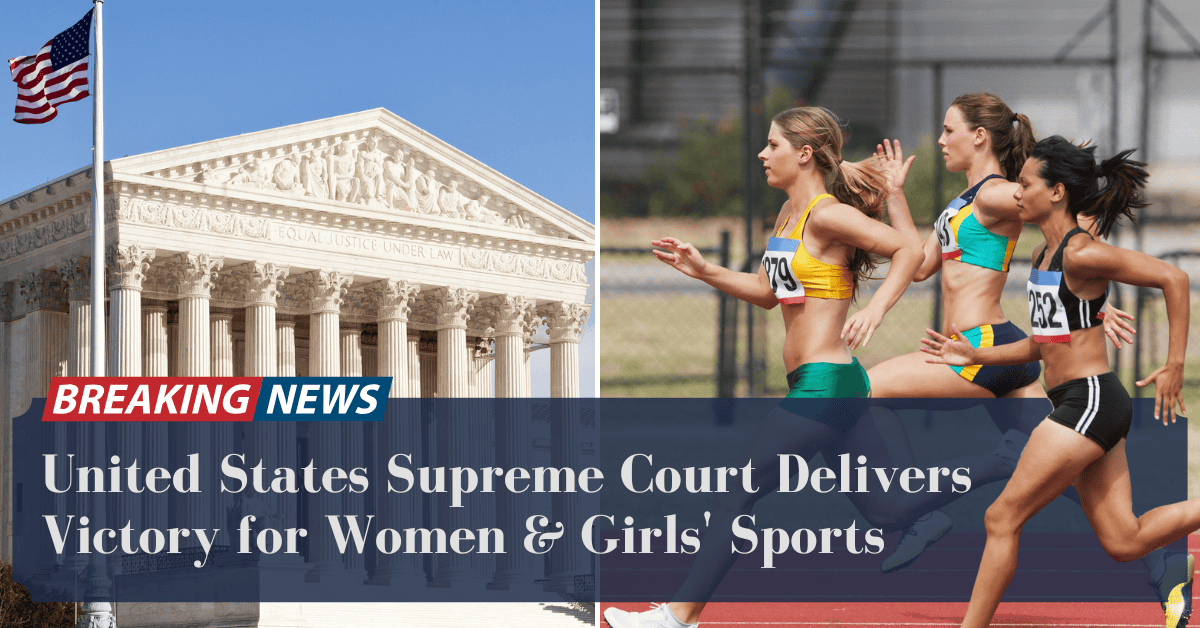
Athletes for Action Applauds Supreme Court Decision Protecting Girls’ and Women’s Sports
Decision Marks Historic Victory, But the Fight for Fairness Continues June 30, 2026 — Athletes for Action applauds...
Inquiries?
Get in touch with Athletes for Action.
Email:
info@athletesforaction.com
Interested in creating a A4A chapter at your high school or college?
Please reach out to info@athletesforaction.com today.
At Athletes For Action, our mission is to educate, empower, and advocate for Title IX and the advancement of girls’ and women’s sports while protecting the integrity of these programs. We believe in giving parents and girls a voice, ensuring their concerns are heard and valued as we actively lobby for girls’ rights in sports and push for equitable policies and legislation. By working collaboratively with schools, leagues, and stakeholders, we develop innovative solutions that guarantee fair locker room spaces and athletic opportunities for female athletes. Our commitment is to foster a culture of inclusivity and support, enabling every girl to thrive in a safe and empowering environment, while we strive to break down barriers and create a brighter future for women’s sports by upholding the rights of female athletes at all levels.